
The Inner Perimeter: is the heart of the A- camp, the most hardened part of it and where all strike operations as well as administrative and logistic operations are conducted from. This perimeter is usually surrounded by an earth berm or wall with bunkers for automatic weapons and numerous individual fighting positions. The security of this inner perimeter is usually the responsibility of the best Strike company and the Recon Platoon.
The following positions are usually located within this area.
The US
Special Forces Team House (1)
Host Country Counterpart Team House
Commo/Toc Bunker (2)
Medical Bunker
Inner Perimeter fighting Berm (7) Bunkers
(8,9&11)
Inner perimeter Security Force Quarters
Generator Bunker
Mortar Position (6&7)
Fire Arrow
Supply/Arms Room (5)
Latrines (16)
Ammo Bunkers
Vehicle Bay
Fire Fighting posts
The Inner Barrier:
is the defensive obstacle zone surrounding the Inner Perimeter and comprise of barbed wire entanglements/fences as well as mine belt covered by fires from the Inner Perimeter. The Inner Barrier is wide enough to prevent enemy from getting within grenade throwing range. There is two access via this Inner Barrier, one from the main access road (for vehicles entering the Inner Perimeter) and the other being a small Personnel gate linking the Inner to Outer perimeter. Both of those gates are guarded at all time.
In General
you would find in the Inner Barrier most of the followings:
Double
Apron Barbed Wire Fence, Mine Belt, Tangle Foots, Triple Concertina, Wire Fence,
Channelizing Fences, Communication Trenches (linking Inner to Outer Perimeter)
and spread amongst those defenses, you will also find Trip Flares as well
Fougass.
(Please note note
the defenses varied a lot
from one camp to an other as well from one year to another)

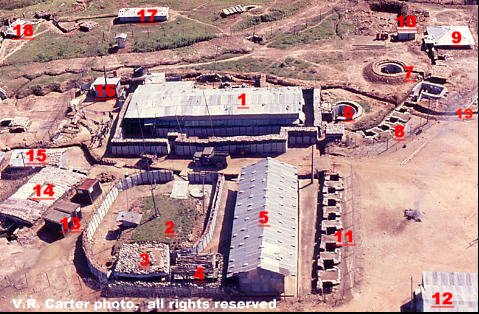
An
aerial of Gia Vuc inner perimeter. Team house and adjacent
underground radio bunker, taken from a chopper overhead.
(click on some of the numbers and you will be taken to relevent photos, note not all numbers are opperational)
You can see:
1) USSF Team house: this was constructed above ground but protected by chest high sand bag walls. This served as the administrative HQ for the US detachment. It did contain offices for the detachment commander and the operations sergeant, a mess/recreation room and sleeping quarters for some US personnel. The fact is that most USSF personnel slept at key bunkers, usually in the inner perimeter. This minimised the risk of wiping out the team in one hit and also ensured that team members were at their assigned place if an attack occurred.
.jpg)
SF team photo inside team
house
Left to right: CO, CPT Robert O Scheer, unidentified Mike Force
Australian
from Danang, SFC James (?) Hoskins (Hvy Weapons), SFC James McGlon
(Intel/TmSgt), unidentified Mike Force Australian from Danang, 1967.
The team house was relatively protected from direct fire weapons by 6-7 foot high sand bag walls outside the team house. But the team house walls and roof were simply corrugated sheet metal over wood or steel studs, so any indirect fire weapon hitting the roof would have quickly destroyed it, and created casualties of anyone inside. Few of the team slept in the team house. All of us had concrete and sandbag bunkers where we slept, and which functioned as various defensive positions. When intel told us that an attack was possible or imminent, we didn't use the team house at all! The fact that you see folks in the team house, in various dress (or undress) indicates the level of threat (at least as far as our intel nets and recon platoon could discover!).
.jpg)
A-103 members relaxing in the team house, Cpt Scheer and Medic B Long,
1967
.jpg)
Team house and electric generator shed in
1963,
you can see the aerial mast of the commo room

2)
Commo/TOC bunker: the patch of
green grass you see is the roof of the Commo/TOC bunker. This was the
strongest underground position of the camp and it housed the radio rooms
as well as the Tactical Operations Center. The access was limited to US
personnel and a few counterparts. This usually was made of 3 rooms, the
TOC room and the two radio rooms (one USSF and one LLDB).
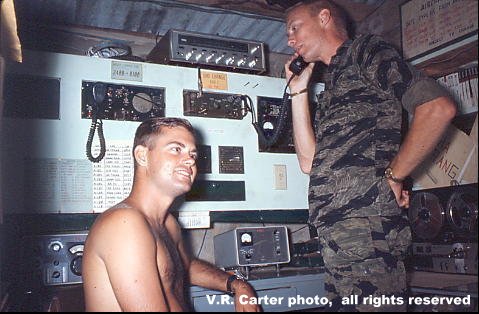
A view from below.
Jr. radio man Charles Woodson and Cpt Virgil Carter, with various radio gear behind. If you look at the ceiling you'll see the standard corrugated metal with earth and sandbags above, 1967
.jpg)
In 1963 the commo room was in the team house!
3) Generator shed/bunker
(Check Gary Bowes website for the BIG RAT incident)
4)
petrol (gas) storage -- 55 gallon drums
were stored in there.
5)
USSF Supply Building: also called
S4/Arms Room this building like
the team house was above ground but protected by chest high sandbagged
walls.
This building contain supplies and equipment needed to sustain the camp
during normal/defensive operations. The Arms Room will be within this
building and will secure weapons not needed at the time. Usually
the S4 personnel would be located in that building.
6)SF
81mm Mortar
pit: similar to no 7
7)
SF 81mm Mortar pit: This
is a typical view of the layout of a A-camp mortar pit. Dug
in position with elevated berm/sandbags walls, you can see the the
"ready ammo holes/box" (55 gal gasoline drums set horizontally
into
the concrete sides of the pit) with rounds out of their cardboard
packing cases, this is protected from the rain by a poncho.
On the bottom left hand corner you can see the trench leading to the
ammo bunker, were HE, WP and Illumination rounds would be stored.
In the top left hand corner of the
photograph, you can see the US Team house and protecting walls as well
as some of the interconnecting trenches. Right hand top corner you can
see part of the inner perimeter wire. Could the small building in the
middle be latrines??
This photo belowis from the Gia Vuc USSF 81mm mortar
pit, inside the inner perimeter, adjacent to the team house. You
can see the night aiming stakes placed around the perimeter, but for
some reason, the information cards were not in place when the photo
was taken also you can deduct that the camp
on that day was at a low stage of alert, half the team has gathered presumably for the photo!
.jpg)
SF team at 81mm mortar
pit, conducting firing registration
Left to right: SSG FranklinDailey (Demo), CO, CPT Dallas Cox
(preceded
Scheer), ??, (I believe next man to be senior medic SSG Paul Whitehead),
SFC
Mike Meade (Intel--preceded McClon), and in the pit, SFC Louis Wardlaw (Hvy
Weapons), 1967.
8)
Inner perimeter protective berm with fighting trench/positions.: the
inner defense perimeter was most of the time build with bunkers and fighting
positions situated on a berm. This allow in case of an attack the
inner and the outer position (dug in) to engage the enemy. Also see No
11.
9) CO/XO sleeping quarters & bunker defending main/secondary gates: This was a key position in the defense of the camp knowing that Gia Vuc like all USSF camp had VC infiltrators in their CIDG forces. This bunker was armed with a BAR gun and was only a short distance from one of the main weapon, the 81mm Mortar pit, please note the connecting fighting trench to the bunker and the team house.
10)Can
somebody help?
11) Inner perimeter berm/fighting positions: see No 8
12) Building
used for operational briefings,
pay day for CIDG, and general
assembly functions. No 12 operational briefings
building is in the left back ground of the photo
and in the right
corner is building No 5 Supply building
.jpg)
(photo taken in 1965 with temporary commo bunker in the middle)
13)
Conex containers for storage for SF
14, 15, 17, 18)
CIDG company quarters
16)
SF shower & latrine
19)
Trench connecting USSF to LLDB team houses
.jpg)
Photo of a Day-time Medcap
patrol going over the main trench line connecting the LLDB to the USSF
team houses.
The building in the back ground is the USSF supply building,
with the USSF team house in the right corner.
I believe, this is not a small bridge over the trench but the trench
itself has been filled due to the lack of trust in the LLDB.
LLDB 81mm Mortar enclosure : This is a typical view of an "above ground" A-camp mortar enclosure. The small bunker at the back is were the ammo was kept.
Can anybody locate the location of this mortar enclosure on the aerial shots?
.jpg)
View of 81mm LLDB/CIDG
sandbag mortar enclosure:
Taken in 1967, shows registration of the LLDB/CIDG 81mm mortar by SF
team
member, SFC Charles Lindewald (Lt Wpns). He later joined the Mike
Force and
was MIA/presumed KIA at Lang Vei when NVA tanks over-ran the camp in
early
1968.
